How’s Our Building Doing? Mapping Business Processes in Strata Management
In partnership with a recognised Australian strata management company, we supported a deep analysis of their strata management processes. The goal of the project was to understand how actual work was done, where challenges occurred, and what opportunities existed to improve employee performance, satisfaction, and customer experience.
Feedback
“You’ve helped me feel and see the plight of our customers and the people doing the work.”
“You’ve helped me see the places we’ve just adapted and places we could have done a lot more.”
“You’ve really opened up my eyes to the complexity that everyone is wading through to get the job done.”
“At first I was a bit despairing, but now I’m excited because I feel there is a path to making it better.”
Successes
Made actual processes visible: By engaging with the people doing the work and mapping detailed business processes, we made work visible. This was essential in helping the business leadership understand where to focus their operational improvements.
Identified challenges and opportunities: While analysing business processes, we collected challenges at key points of the process, but also where employees had developed elegant workarounds or had ideas for new solutions. A clear list of challenges and opportunities gave the business a logical starting point for people, technology, process, and experience fixes.
Increased leadership alignment: Leaders across the business were all working hard to keep up. By setting aside a few protected days from their regular tasks, and working with us through the detailed business processes, we helped leaders gain deep insight into the challenges and start forming strategies for exploring solutions.
Challenge
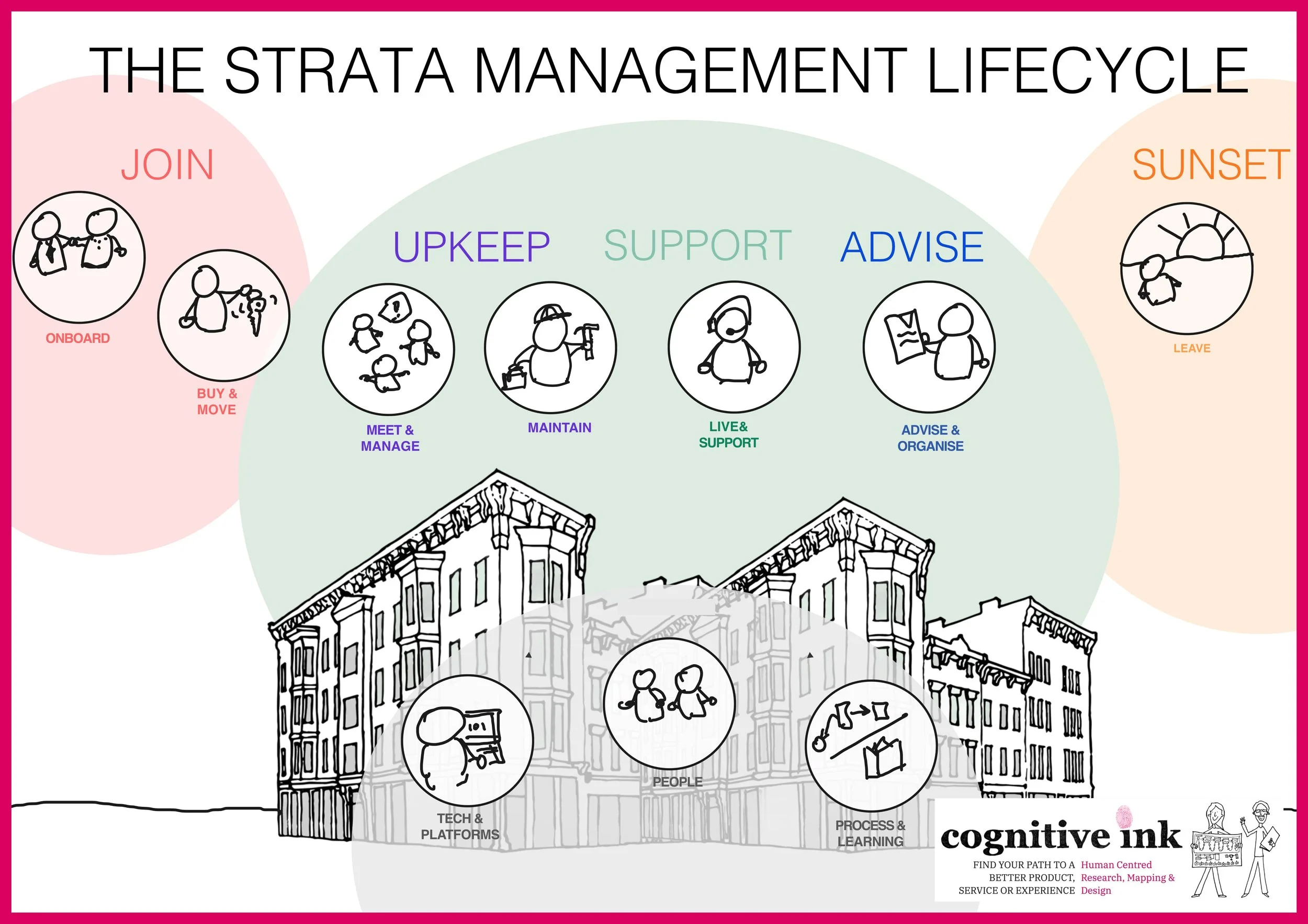
Strata management is the administration of shared properties, like apartments, duplexes or townhouses, on behalf of the owners. Strata management ensures that all common areas, building services, and compliance activities, benefit all residents.
It’s a demanding and complex domain area, given that the strata management company is working on behalf of a group of people, the Owners Corporation behind the strata plan, whose aims, understanding of the issues, and priorities may not align.
Within strata management, there are many roles, hundreds of workflows and key documents, and significant compliance and regulatory requirements around every aspect of the business.
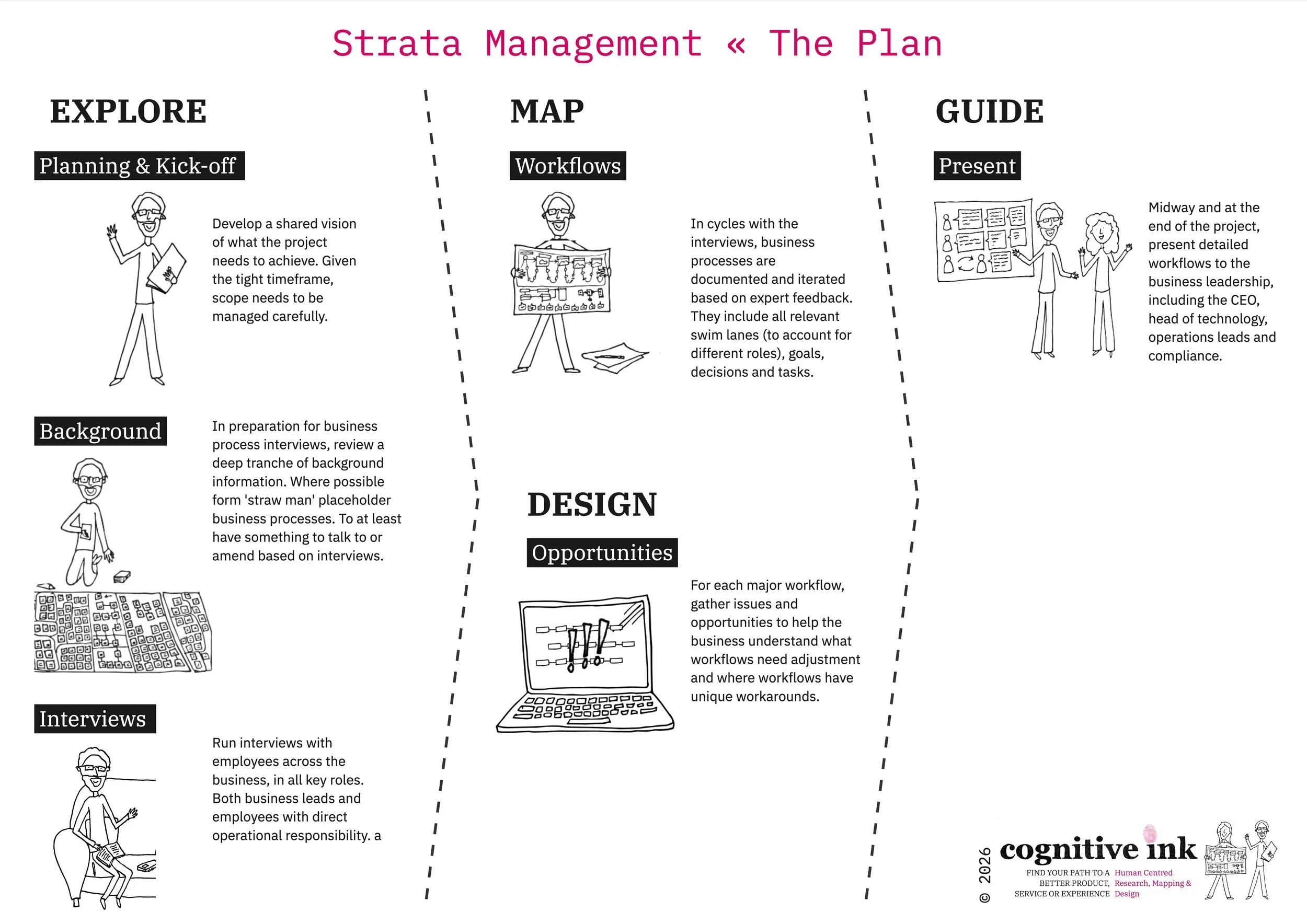
Cognitive Ink joined two other design partners, to support a tactical nine-week business processes mapping activity, meant to cover as much of the business workflow as possible. This included a review of business processes from within Risk, Compliance, Repairs, Finance and the Annual General Meeting.
© 2026 Cognitive Ink
It’s challenging to map complex business processes as the task requires hands-on human-to-human inquiry (e.g., interviews and onsite observation), as well as the review of many detailed documents, legislation, systems, assets, reports and other business ephemera.
Crucially, the goal was not to map the theoretical ideal process, but the activity being executed at the workface. This meant sitting with people doing their work and following along with their activities as they performed them.
Our approach to solving this challenge focused on a rapid weekly cycle of gathering background materials, preparing draft business process flows, sitting with business leads to go through work activities, and iterating based on feedback.
© 2026 Cognitive Ink
Approach & Deliverables
The project needed to make smart choices about how to actually do the mapping activity. For example, if analysts and designers choose to create detailed business processes in a classic flowcharting tool, they can fill in rich detail.
However, updating maps is hard because the team must physically move dozens of shapes around the flow as they add new information. Put another way, making the right choice of tools can sometimes shape the project’s success. It isn’t ideal to have a team spending all its time updating maps and less time talking with employees.
To balance speed versus detail, the team investigated options and settled on a Microsoft Visio plugin called the Microsoft Data Visualiser.
Using the visualiser, the team captured the workflows in a spreadsheet (table) format. This allowed extra metadata to be captured for each step of the workflow (roles, business rules, tools used, information captured, time taken). Then, using the plugin, we turned the spreadsheets into visual, swim lane-based workflow charts.
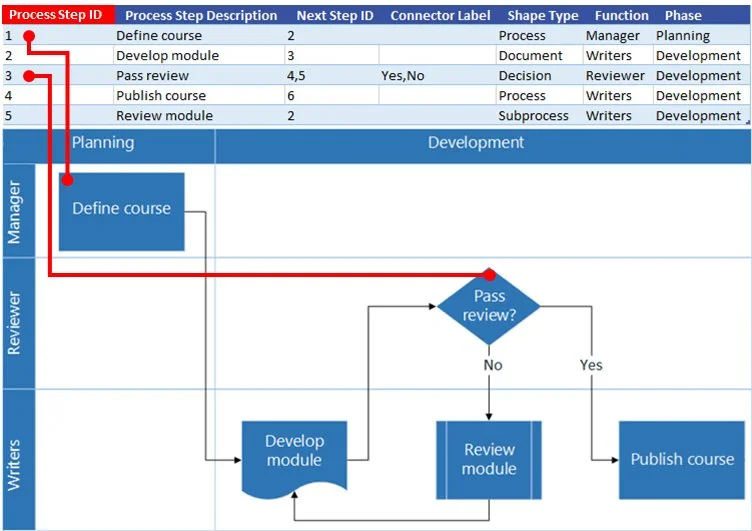
This visual workflow made it much easier for the business to ‘see’ the process being executed across the various roles. While still being able to audit the details of the underlying table; the best of both worlds.
This approach allowed the team to generate dozens of business processes in nine weeks. Sometimes iterating workflows ten or more times to ensure they matched the work actually done.
The act of mapping ‘lifted’ pockets of activity into the light, making it much easier for the leadership to see down into the business’s real day-to-day behaviours.
The workflows, in both tabular and visual form, plus any assets, information or work detail gathered along the way, formed the backbone of the delivery.
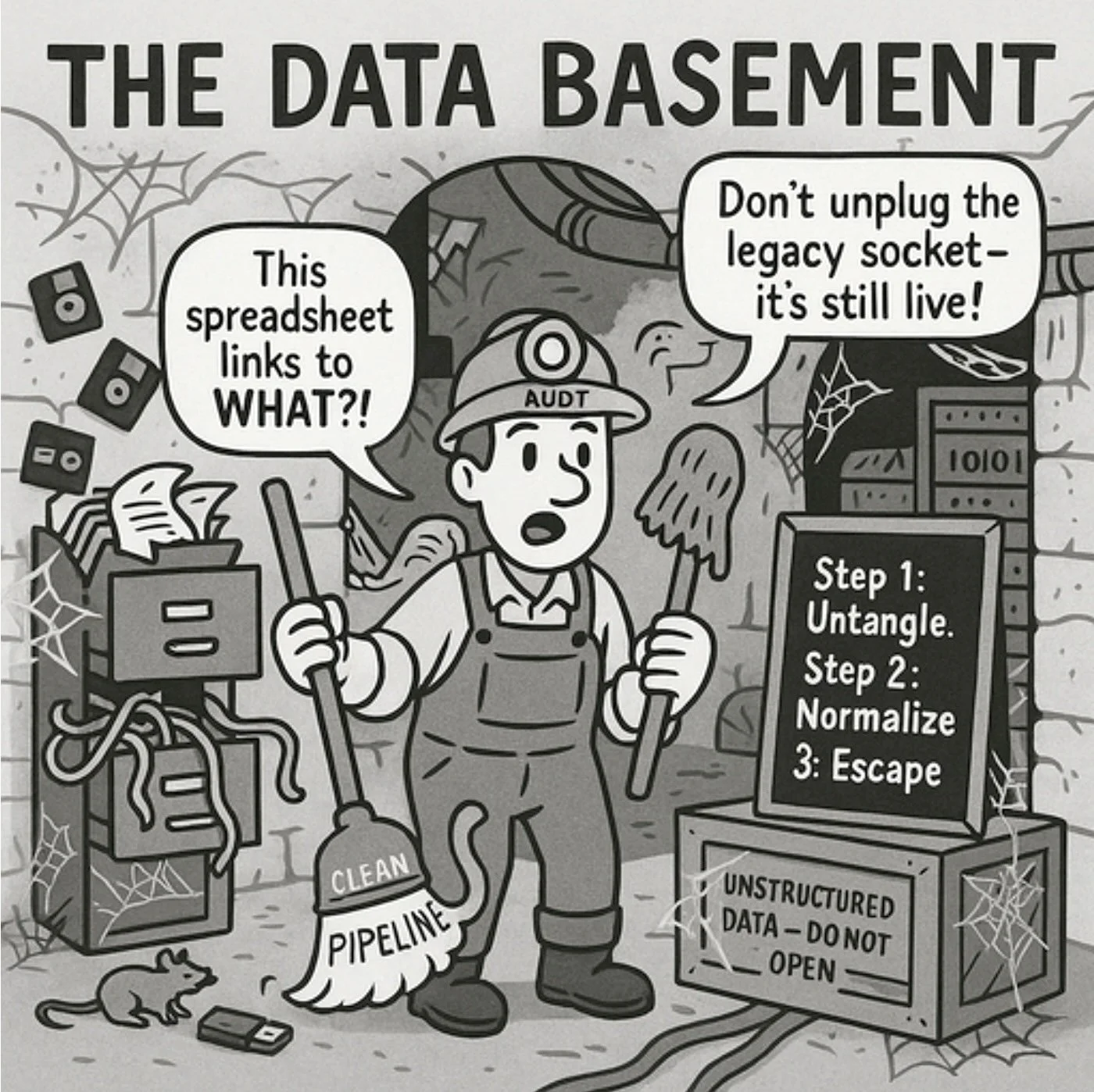
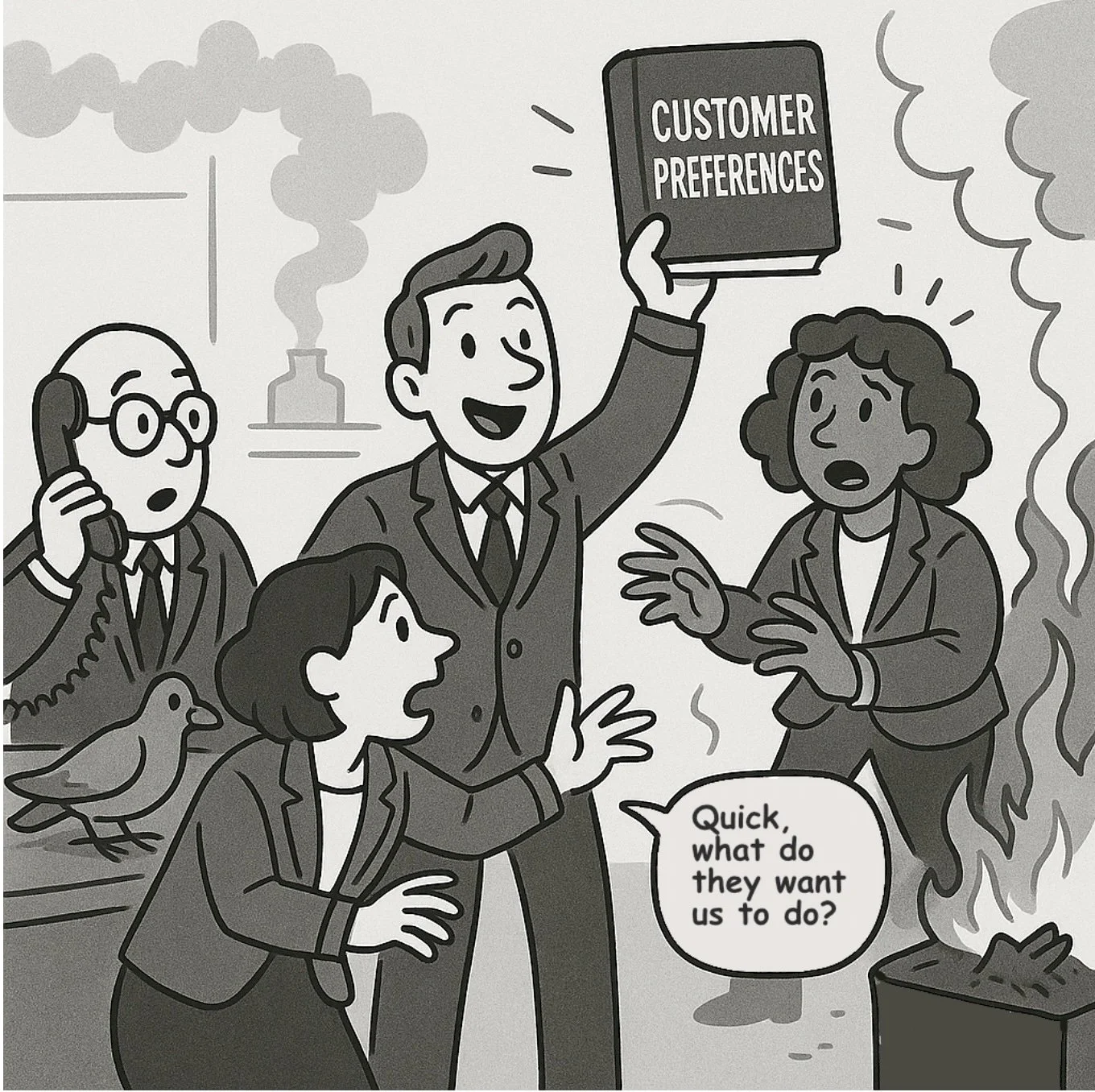
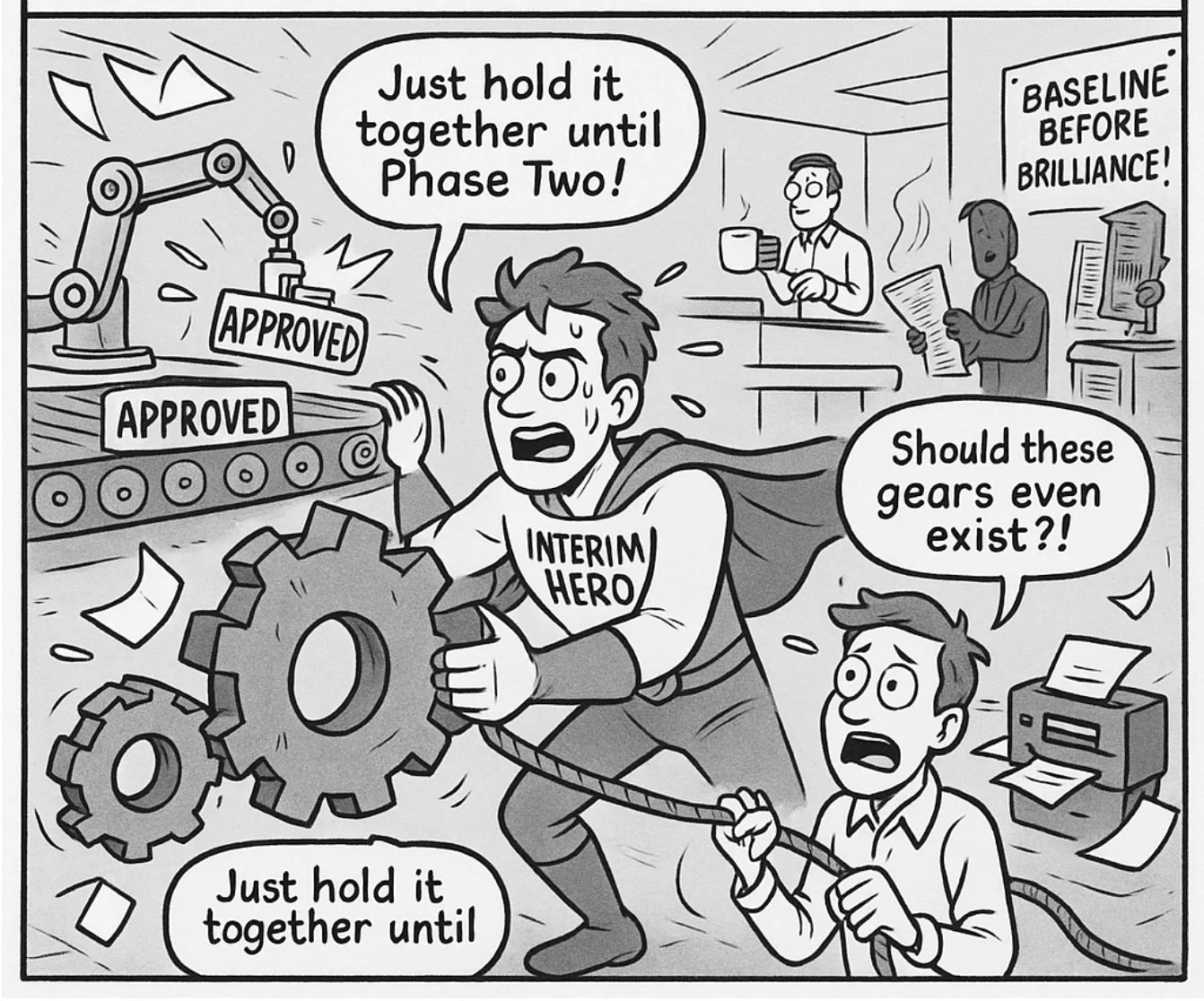
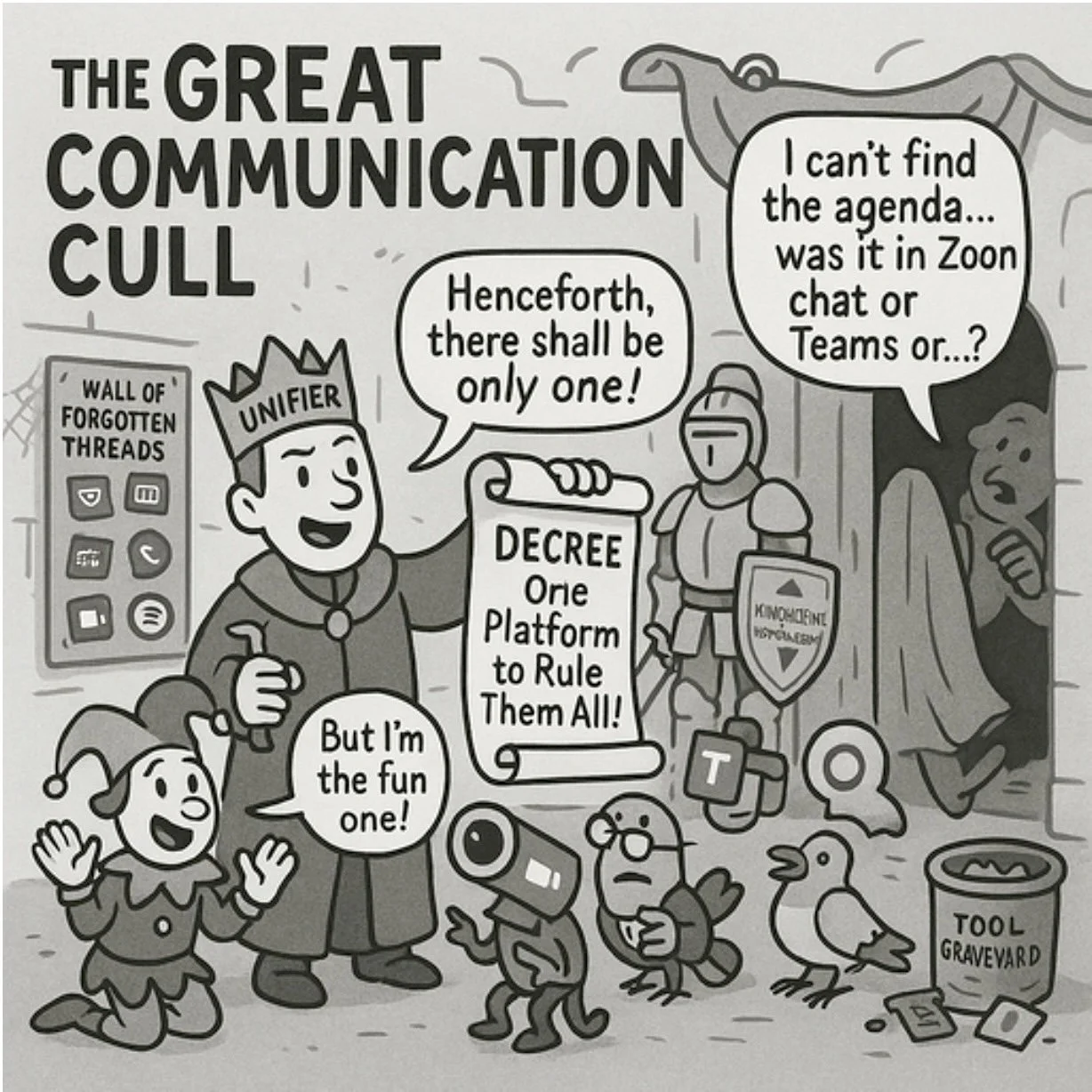
The team also gathered challenges and opportunities from across the business, organising and theming them for clarity. Where possible, we used approved in-house Generative AI tools to visualise the themes comically. This helps give imagery to abstract ideas.
Insights & Outcomes
The CEO and leadership team received the first tranche of work halfway through the project during several full-day workshops to keep them updated on findings. Though workflows remained incomplete, the leadership team needed to grasp the key discoveries about actual work processes.
Most leadership teams only ever review summaries of findings, so it was unusual to take so much time to walk through the detail. But the time was to ensure detailed business processes were operating with compliance, efficiency and customer centricity.
The business process mapping gave the business a fresh perspective on how work was being done, where the challenges and opportunities were, and how to prioritise changes in the future.
This project represented one of the ‘unsung heroes’ of Human-Centred Design: the detailed process mapping and onsite exploration of context-rich work activities.
In the CEO’s words, the mapping provided ‘a path to making it better.’