What’s Wrong With Me? Exploring a Central Source of Trustworthy Health Information and Advice with Healthdirect
How do people figure out what information and advice they can trust when navigating complex healthcare experiences? With Healthdirect, an Australian Government-funded health information and advice service, we set out to explore the individual health journeys of everyday people, unpacking the highs and lows of their healthcare experiences.
Feedback:
“I am always impressed with the insight and quality of outputs that Cognitive Ink achieve in every engagement. Anna and Christopher’s meticulous approach to preparation and execution adds value to product and service design. I have worked with and engaged Cognitive Ink in three different organisations and highly recommend them.”
“You guys have really hit a home run here at Healthdirect—your work quality, your work ethic and the outcomes are top-notch for a high-profile service.”
Our work:
Surfaced genuine customer voices: By engaging with potential end-customers of the service, we surfaced rich stories of behaviour. This provided a powerful source of guidance for improved and new services.
Uncovered significant challenges and opportunities: Customer research uncovered significant challenges people encounter when managing their healthcare. But also opportunities to change processes, technology, and experiences for the better.
Unified the operations team: We worked with the client to bring together all key stakeholders in the operations team for a full-scale debrief on the insights. A day of extended storytelling can be challenging to orchestrate, but is also beneficial. Stakeholders get to understand the insights and cross-pollinate ideas in a live session.
Showcased the future: By building research-driven, customer-centred, future-service storyboards, we helped the team creatively explore what the Healthdirect service could look like.
Challenge

Healthdirect offers a service founded with the noble purpose of helping the public get access to health information and advice, as well as navigating the complex world of healthcare services.
Healthcare in Australia has several useful, but also overlapping, services vying for attention and funding. There is a significant role to play for anyone that can be an ongoing trusted partner across the wide range of healthcare journeys that everyday people have when managing their health.
Healthdirect is one of Australia’s most trusted government-funded sources of health information and advice. The organisation had carried out several research activities leading up to our half-year engagement, but asked us to provide a new baseline understanding of how real people experienced the healthcare system.
The project team identified two initial questions to be answered with the Human Centred Design:
How can the client do more for the same dollars, with the same or different services, delivering the same (or better) quality of service?
Sub-questions:
- How does the service grow in a way that is both sustainable and valuable?
- What could increase the reach of the research, helping the people most in need?
Are there new services that offer a significant increase in end-customer value?
Sub-questions:
- How could the service help people navigate the health system?
- How could the service reduce hospital readmissions and slow the evolution of chronic diseases?
Approach & Deliverables
In collaboration with the client, Cognitive Ink developed a Human Centred Design approach that sought insight into informative customer experiences. The heart of the approach was a series of deep customer interviews.
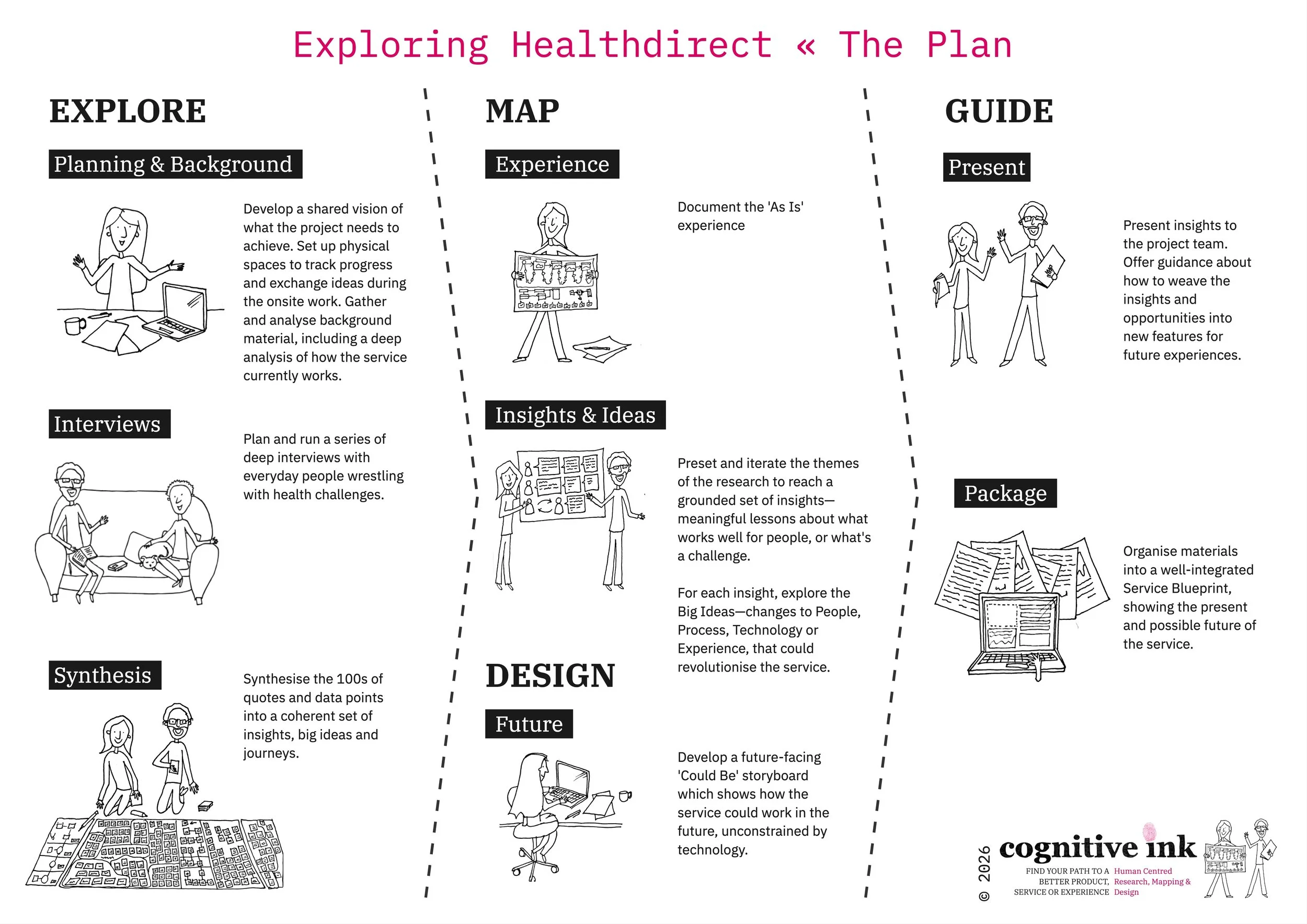
Healthdirect Plan
There’s always a trade-off when talking with people about a product, service, or experience. The more people you talk to, the more consistent the insights. However, the more people, the more time and money required to carry out the research. And there’s a point at which you’ve learned as much as you will, within the constraints of a single piece of research.
Personal surveys are useful in reaching many people with less time, and money spent. But surveys often cannot understand ‘why’ people do what they do, or the subtle details of ‘how’ they do it. It’s only in conversation or direct engagement with people, that these underlying causal truths can be revealed.
In order to understand people’s healthcare experiences, Cognitive Ink conducted multi-hour, one-on-one interviews with six members of the public who’d experienced recent health events, or dealt with an ongoing illness within the previous three months.
During the interviews, the host from Cognitive Ink explored how people managed their healthcare journey, how they found and understood health advice, identified pain-points, opportunities for growth, and positive experiences.
Finally, we sampled how people understood future technologies that might be used in healthcare. With patience and kindness, we listened to people’s experiences and recorded a library of stories.
Along with camera recordings, we used sticky notes, live in session with the participants, to document key quotes. This allowed people to correct or enhance the host’s understanding of their stories in real-time.
We synthesized hundreds of quotes, hours of footage, documented healthcare experiences, and photographs into a set of core insights about Australian healthcare. The insights enabled the team to build an ‘as-is’ experience journey for the service.
Then, we pushed forward with visionary big ideas and storyboards about how the service could work. These sorts of creative assets are like ‘scaffolds for thinking’ about the future. They allow teams to experiment without committing to new technologies or processes.
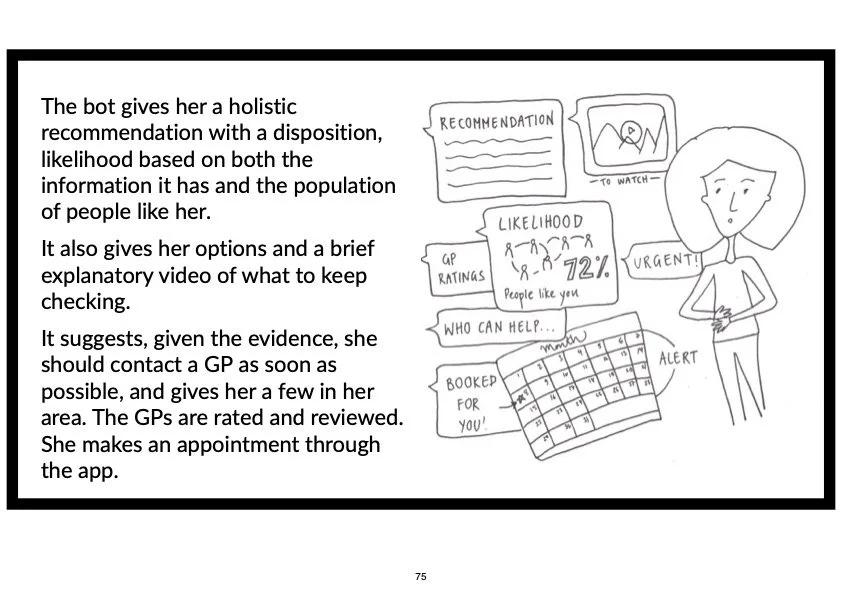
Futurecasting with exploratory storyboards
Insights & Outcomes
*Names, details and descriptions obscured and aggregated for privacy reasons.
Julia’s* voice is low as she describes the sequence of events that led her to being diagnosed with a complex intersection of health challenges. She faces a very uncertain future, despite having reached a sort of balance with her healthcare providers, treatments, social support, and body. By listening to her story, with care and concern, we’re able to learn what it means to navigate the Australian healthcare landscape.
What is startling, is not the medical challenges but the moments of deep tension. Julia recounts how medical professionals refused to listen, bamboozled her with jargon, couldn’t give her the information to decide, didn’t see her health as holistic, and failed to address the emotional side of her experiences. She talks about the difficulty of pursuing a career and maintaining friendships against the backdrop of her health challenges.
Worst of all, she’s not unique.
Many of the people we spoke with, told the same story.
After all, healthcare is a vast industry with financial incentives. Which means it sometimes acts like a machine that consumes money, time and resources to ‘fix’ bodies, in isolation of people’s decision-making, feelings, lives and related challenges.
Some people have a wonderful experience, but usually because of quality interactions with individuals, rather than the commercial healthcare system.
One of the biggest insights was how much everyday people must “be the glue” while playing a “cat-and-mouse game” to navigate their health challenges through a fragmented, confusing, and confronting health system.

Navigating the health system
As part of the research, we developed a set of design principles that would guide any future system design for Healthdirect, including:
Be multichannel
Handle the first contact well
Provide decision support
Cover the Continuum of Care
Help people manage their own health
To socialise our work, we guided key stakeholders across the organisation through the insights and experience journeys in a series of engaging and interactive full-day workshops.
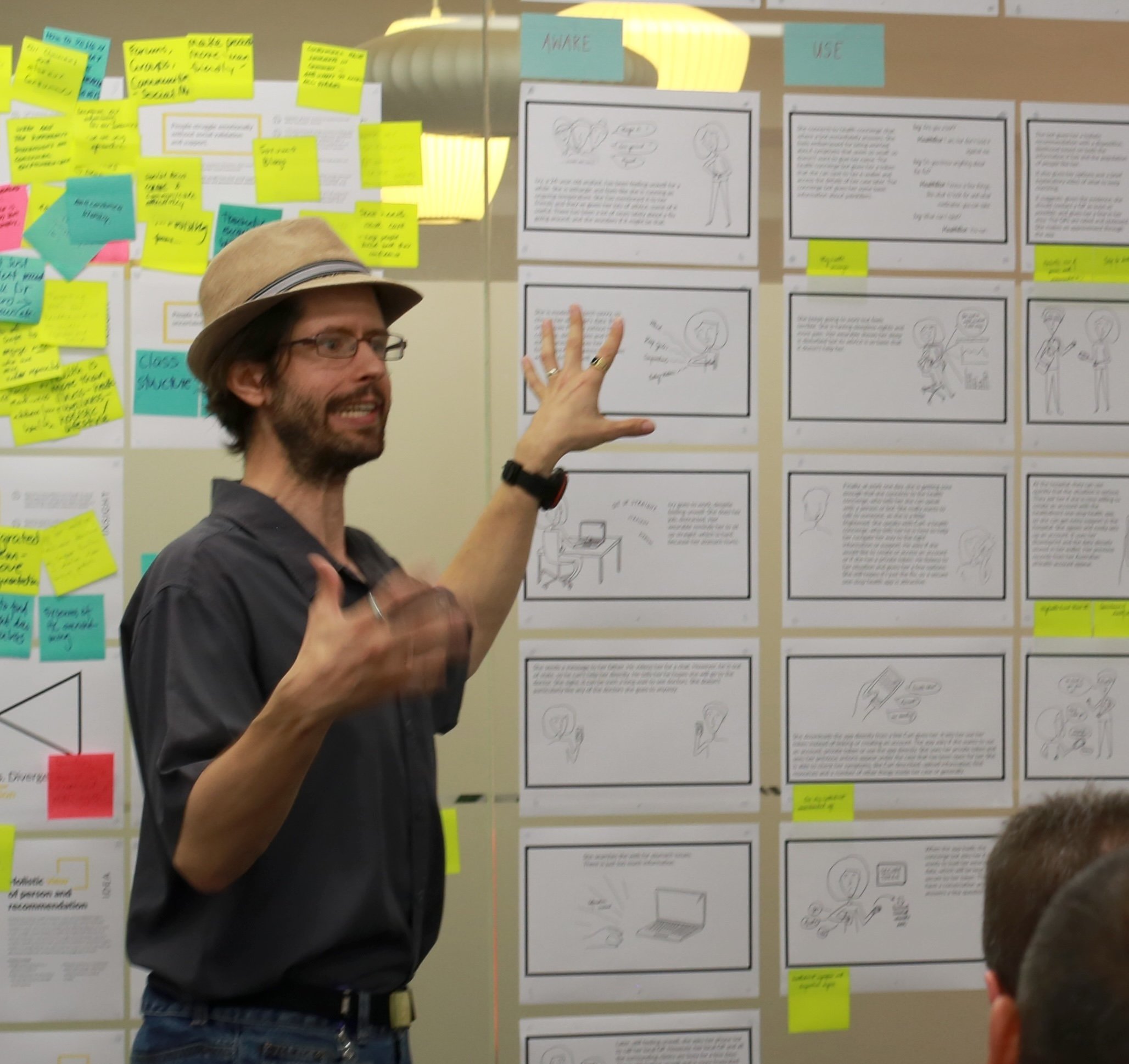
Christopher presenting in workshop
Then we followed our debrief with an integrated research document and service design blueprint for future reference.
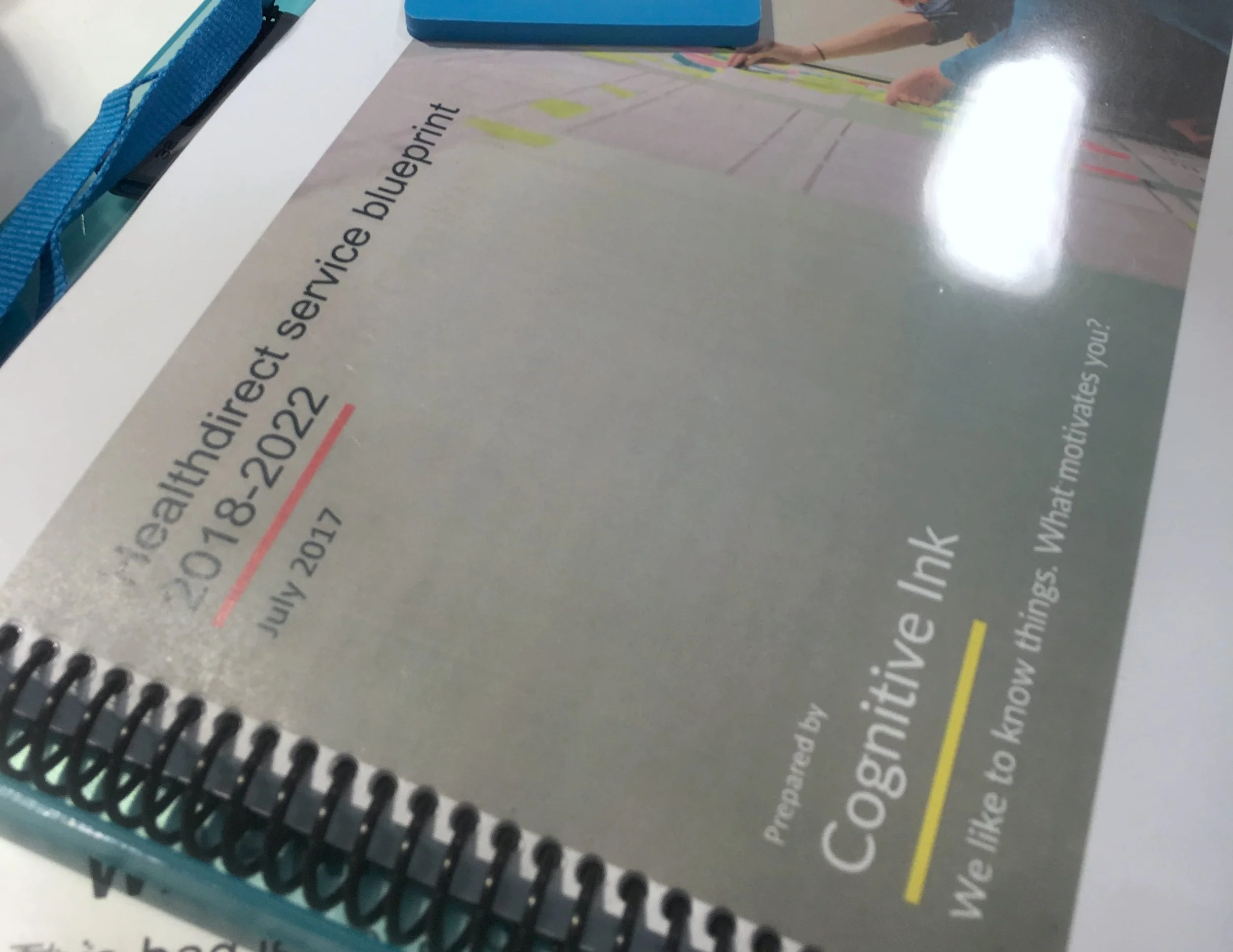
Healthdirect Service Blueprint
Ultimately, our insights helped the organisation enter a key business transformation and gain further funding to offer crucial support along the entirety of people’s health journeys.