Can We Build It? Understanding How Engineers and Customers Collaborate To Deliver Large Infrastructure Projects
With an Australian-based global engineering company, we talked with engineers, customers and partners to learn what underpins success in the delivery of complex infrastructure projects.
“You two are the king and queen of design research. It’s not just about the insights, it’s about how you raise them up into the business… You never fail to astound me.”
Our work:
Connected with customers: It was incredibly valuable to engage with some of our client’s large customers. By participating in interviews, customers could voice the strengths and challenges in a safe and open forum. The conversations led to new ideas about how to hone existing projects, and how to collaborate more effectively on future work.
Identified high-value activities in a formal infrastructure delivery process: If the delivery of complex infrastructure were a linear equation, then it would be easy to ensure inputs (people, process and technology) always equal an output (a giant piece of infrastructure). However, there are many complex factors, including relationships, information management, and communication, that influence whether a piece of infrastructure is delivered well, or delivered at all. Our work helped provide new insight into how to structure the human side of large infrastructure projects.
Launched a range of useful pilots: Opportunities identified in our multi-year ethnographic research led to experience improvement pilot studies across the company. Opportunities included new ways to capture client feedback, structure project management, manage information, enhance communication and improve relationships.
Challenge
Our client, an Australian-based, global engineering company, wanted to upset the usual pattern of exploring their delivery processes by analysing weekly operations numbers, conducting employee and customer surveys and relying on ‘grapevine’ rumour.
Instead, they wanted to understand two fundamental questions:
First, how loyal were their customers?
Second, could they provide extraordinary experiences to their customers, that built both loyalty and advocacy? Implicit in this second question, was a need to understand what factors contributed most to incredible experiences and outcomes.
The challenge with both questions is that large infrastructure projects are complicated. They last for years and involve hundreds of individuals, or more. They generate reams of information, involve thousands of decisions, and require moments of significant innovation to solve tricky engineering problems.
To understand how these projects work, you have to sort through the complex personal, group, and cultural dynamics at play.
To do this, companies use surveys to capture how well a project went. But surveys are slender and often ambiguous sources of data. People are limited to trying to give complex answers in tiny form fields.
Or, a company might use a blend of after-action reports, ad hoc conversations with project leads, project metrics (e.g., money spent, pace of deliverables) and even internal company rumour.
These methods might provide information, but it’s hard to understand why something is happening.
Instead, we had to approach the challenge differently.
Approach & Deliverables
Deep experience research with customers isn’t easy. It was even more complicated when world events like the Covid-19 pandemic kept people confined to their homes for extended periods.
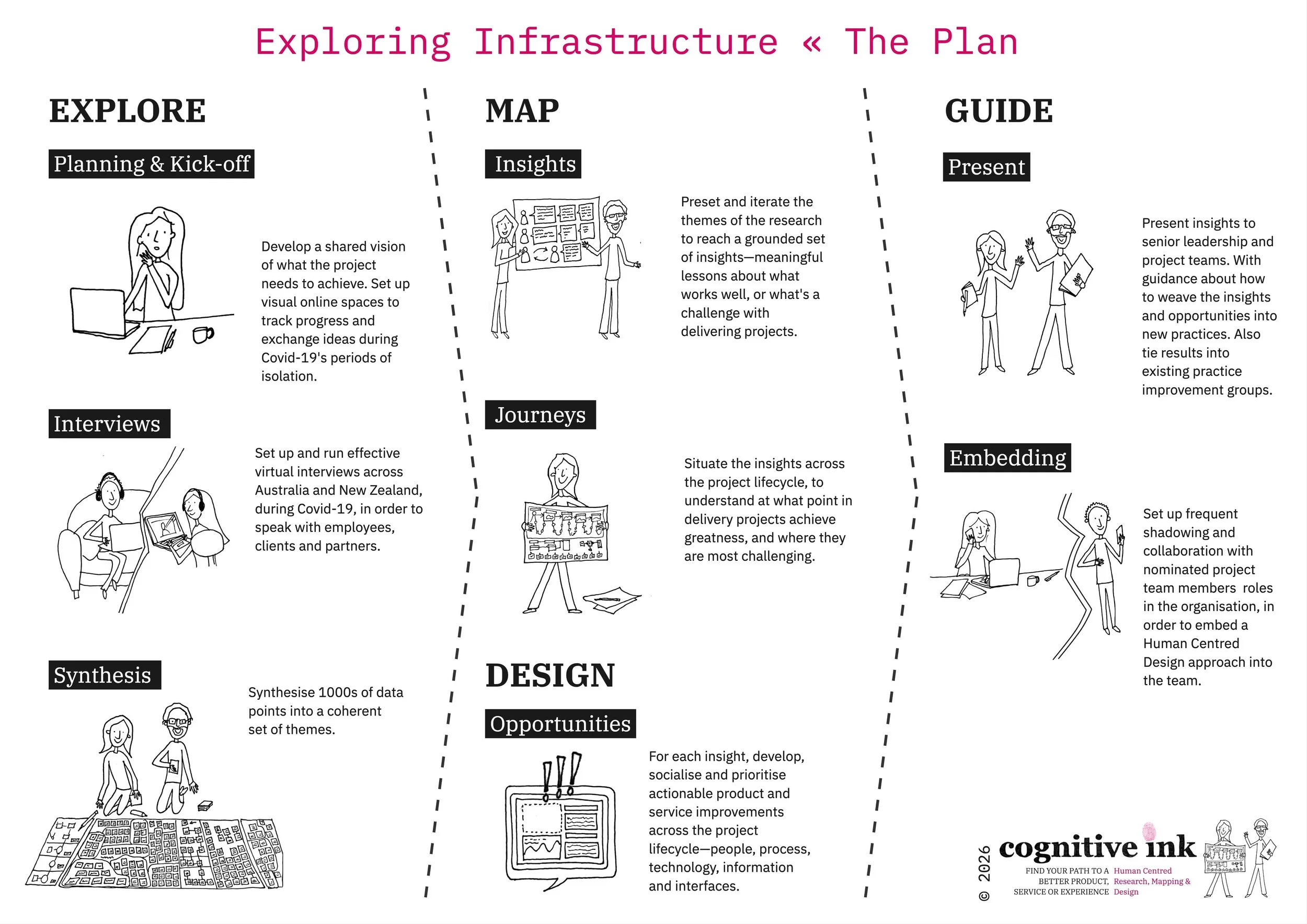
In order to adapt to changing circumstances, and in partnership with our client, Cognitive Ink co-created an engaging one-on-one interview process that used our team as an external, impartial host.
Over private multi-hour phone calls, an interview host from Cognitive Ink, and the engineering participant explored their background, roles, challenges, and opportunities of specific infrastructure projects. The format was loose, allowing unexpected topics to surface during the conversation.
© 2026 Cognitive Ink
The goal of the interviews was to understand the process, its challenges and opportunities, but also to drill down, on-the-spot about why things happened.
Participants told moment-to-moment stories of events, unpicking the meaningful people, process, technology, and experience changes at each step. This allowed root causes to be revealed.
During the sequence, we interviewed dozens of business leaders, employees, partners and customers throughout Australia and abroad.
Interviews included:
Representatives from an external consulting partner
Customers across water, energy and built environment
Internal team members, including project managers and design specialists,
Company leaders and mentors
We conducted interviews over the phone to avoid screen-sharing distractions. We recorded the conversations (with permission), auto-transcribed them, and then pulled out key quotes.

© 2020 Cognitive Ink
The research, conducted over a dozen months, was incredibly productive. The team isolated 1,649 quotes across three customer case studies. Adding to this pool of interview data were insights gained from a review of existing internal surveys, performance measures, and business strategies.
In order to avoid any ambiguity from auto-theming or automated sorting tools, the tremendous volume of material was hand-sorted into a map of twenty-two key themes about the challenges and opportunities of delivering infrastructure projects.

© 2020 Cognitive Ink
Following the interviews, Cognitive Ink assembled the entire set of insights into a comprehensive project debrief. The debrief focused on the over-arching themes across all projects, but also offered specific insights for each of the three major projects reviewed.
Insights & Outcomes
Themes were wide-ranging, including powerful insights about customer relationships, processes, technology empowerment / disempowerment, project and information management, communications, business models and incentives. With each theme offering one or more concrete opportunities, it meant the client had access to dozens of new areas to improve their infrastructure delivery.
To help bridge between the insights and action, we presented our findings in a series of workshops to the CEO and executive team and business leads.
The success of the internal debriefs led to an invitation to present to each of the three customer groups. Customers reported feeling both energised and seen as part of the process, proving that the experience enhanced relationships.
Over the months that followed the last interview, we helped kick off a series of experience improvement pilots, to explore making projects work even better.
Ultimately, our work helped the organisation figure out what was most important to delivering the best engineering and advisory services in a dynamic world.
Citations
Image of Electrical Infrastructure by Bidgee, CC BY-SA 3.0 <https://creativecommons.org/licenses/by-sa/3.0>, via Wikimedia Commons, https://commons.wikimedia.org/wiki/File:TransGrid_Wagga_Wagga_330kV_Substation.jpg