Who Are Our People? Learning About the Different Types of Employees in Engineering Consulting.
On behalf of an Australian-based global engineering and advisory firm, we interviewed dozens of potential, present and past staff members to dig down deep into what matters to people at work, and how lifestyle choices affect career choices. We uncovered key behavioural drivers and challenges from the perspective of several types of employees.
Feedback
“Very insightful.”
“I have spent today ‘properly’ reading and digesting the personas and they are amazing! Thank you so much for all the work you have done on them, can’t wait to start the next piece of work!”
“What you’re doing; targeting and talking to different sections of people and understanding them; I think it’ll make a real difference.”
“I picked up a few things in my own mind to sort of think about and work on, so it’s [been] good.”
Outcomes
Informed award-winning campaigns: The insights were so influential that they contributed to an IBAC (International Association of Business Communicators) Quill Award-winning communication for mid-career employees.
Created a mind-shift towards employee lifestyle thinking: By presenting the human-centred lifestyle-choices framework, we helped both people and recruitment teams see the person inside the role. Which affected the way they both marketed to and recruited mid-career and senior employees.
Identified challenges and opportunities: By doing deep human-centred research, we identified a host of both challenges and opportunities for an array of themes, including: renumeration, work/life balance, leadership, career challenge, workload, information management, communications and more.
Increased genuine employee goodwill: As interview participants noted, being able to explore their needs, challenges, and drivers in a safe setting made them feel seen. This increased genuine employee goodwill, as it showed the organisation was investing in learning essential truths about its people.
Challenge
An Australian-based global engineering and advisory company wanted to understand how to better attract, work with and keep mid-career and senior employees. Both these categories of a workforce are central to an organisations success.
Mid-career employees are the ‘engine room’ of any consulting company, usually near half of the employees in the total workforce. Mid-career employees are usually 2 to 3 years out of graduate programs, ~28 years and older, and are just encountering some of the work/life challenges between driving a career and achieving the things that are important to them outside work.
In contrast, senior employees, usually a quarter of a workforce, represent the leadership, mentoring pool, and technical specialists that guide work to successful conclusions. They are usually early to mid-40s, with 15+ years of experience. Senior employees face the choice of focusing on people leadership or doubling down on technical skills. As per their experience, they have a high level of responsibility and visibility in the company and are well-connected throughout the industry
With ~4,000 employees spread across Australia, New Zealand and internationally, our client was struggling to figure out the best way to make sense of common behaviour patterns in their workforce.
Cognitive Ink was engaged to build up a picture of how mid-career and senior people behave, what motivates them (inside and outside work) and to understand if there were any common needs.
Approach & Deliverables
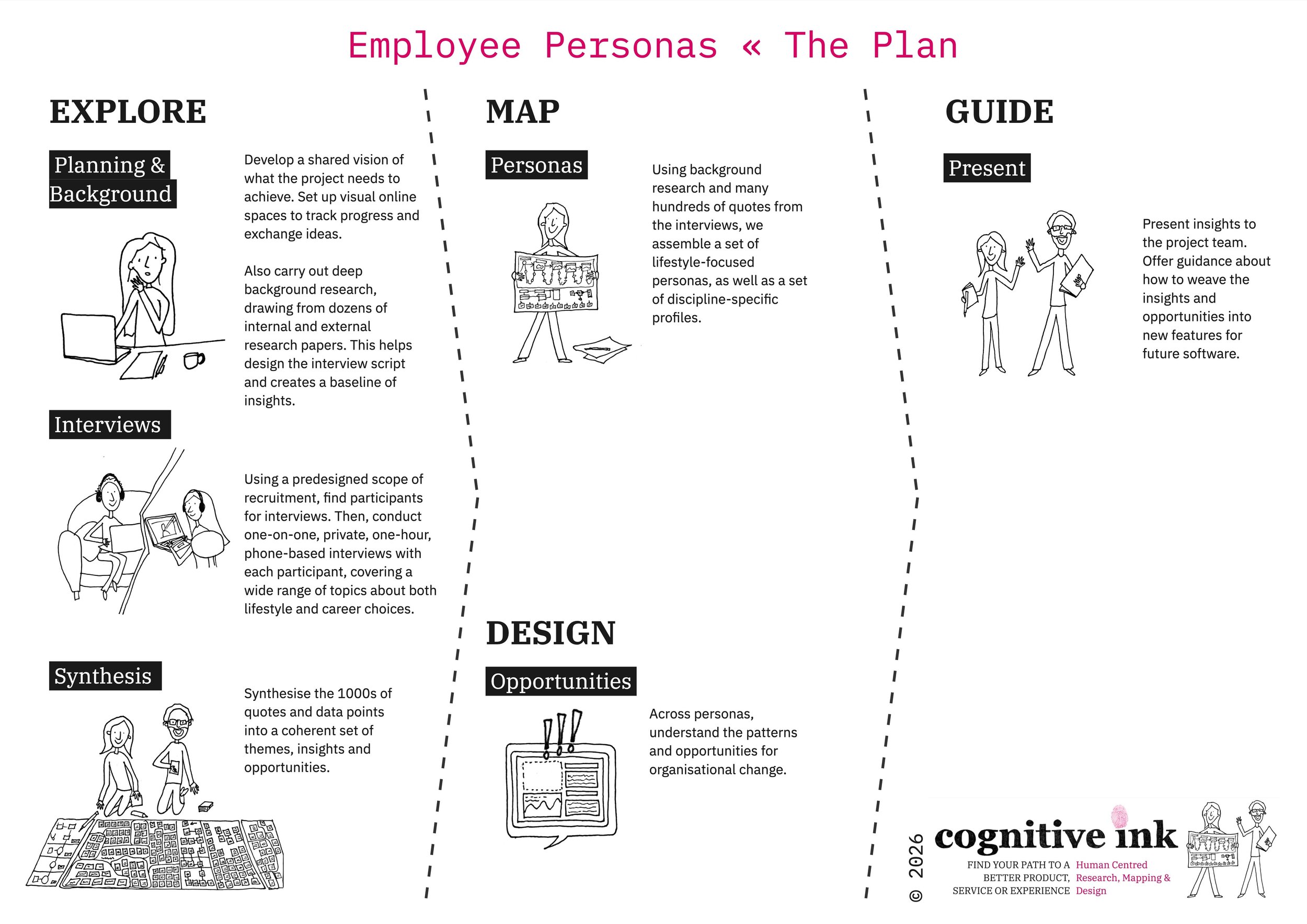
After an initial tranche of background reading, Cognitive Ink developed a direct interview approach for both mid-career and senior leaders. We wanted to talk with people one-on-one, to draw out invaluable personal stories about people’s lives, their career choices, and how the two interact with each other.
By clarifying that we were an independent research team, and with the assurance of anonymity, we find participants are usually very open and willing when it comes to talking about their personal and work lives.
We planned for over ten interviews for each cohort, but ended up with 19 conversations for mid-career and 17 interviews for seniors. This included a mix of potential recruits, current employees, and ex-employees who’d recently left the company. As well as a variation of lifestyle choices, relationships, and experiences.
© 2026 Cognitive Ink
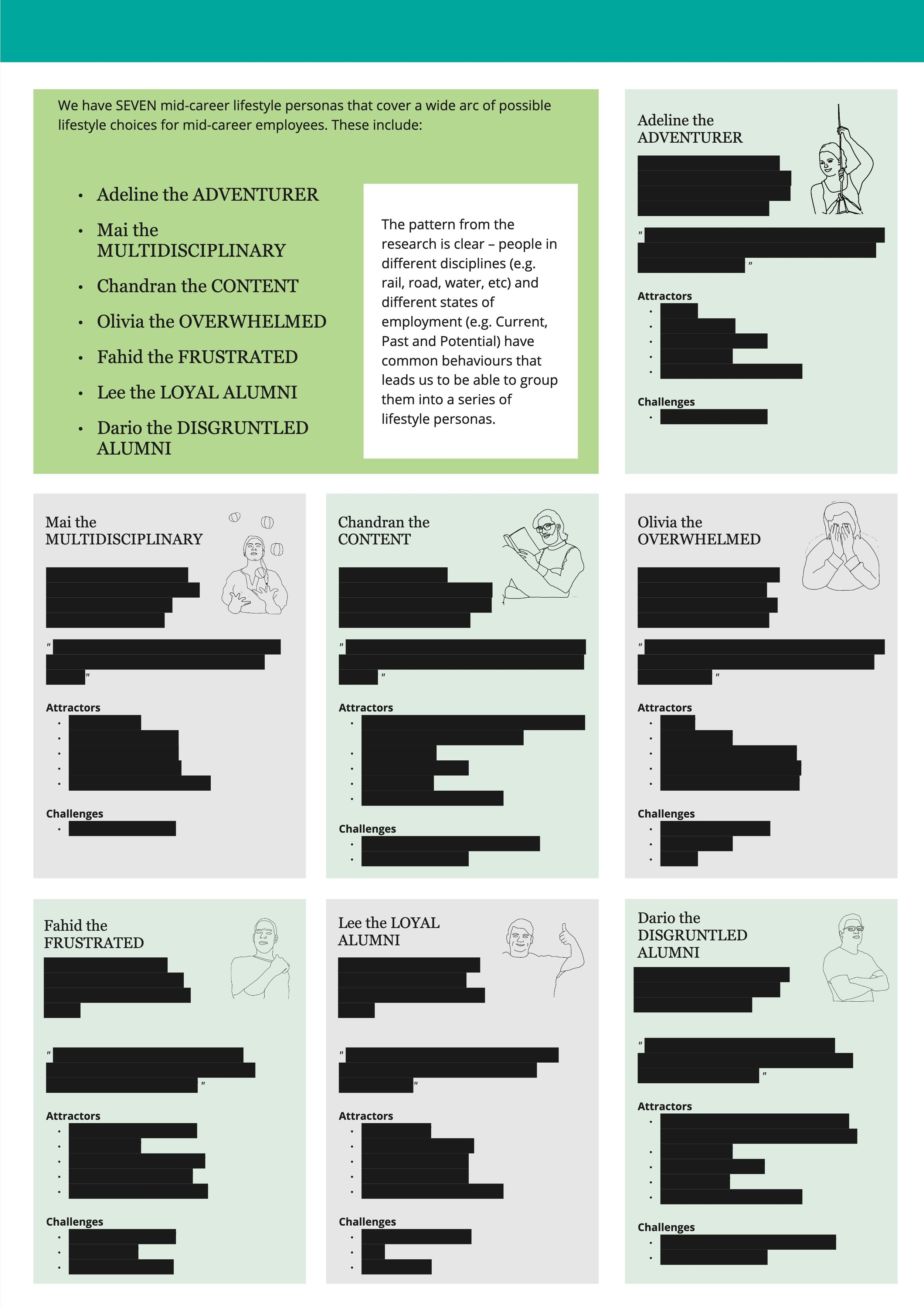
Using results from one-on-one interviews, and along with existing qualitative and quantitative research, we developed a set of rigorous, behaviourally-anchored lifestyle personas to help the client understand how to target recruitment for new hires, reward employees and to support people in times of need.
Personas are a misunderstood but useful tool in the world of Human Centred Design. They are not lightweight, ‘Bob is an admin assistant and likes cats’ marketing segment placeholders.
Instead, they are rich ‘composite’ pictures of hypothetical people, drawing from real-life stories and behavioural research. By distilling the most significant information into composite profiles, personas bring specific common groups to life.
Personas help shift thinking towards seeing people holistically. This helps an organisation understand that personal lives impact and influence careers and work lives. They also help teams decide what different people need, and how an organisation can market, communicate and work with people to create mutually rewarding relationships.
The personas, seven for mid-career and eight for senior, were the core deliverable for the client.
© 2021 Cognitive Ink

© 2021 Cognitive Ink
Insights & Outcomes
In engineering, there’s an impulse to define everyone according to their area of speciality, e.g., water, rail, infrastructure, mechanical, etc. Granted, different specialities coalesce to create a community of practice, mentor each other and expand a domain area.
However, based on feedback from the entire cohort and deep synthesis by Cognitive Ink, we discovered that people’s lifestyle choices are a more meaningful way to understand different behaviours, needs, constraints, and contexts. Lifestyle-oriented personas put human needs back at the centre of an employee-employer relationship.
This ties into the second insight: people’s needs, and their relationship to an organisation, change with different lifestyle choices. Again, putting people at the centre of the workplace relationship means seeing how people need unique challenges and different levels of support.
For mid-career, some of the biggest challenges involved figuring out what ‘levers’ they could pull to make life work, including flexibility, work/life balance, leadership and pay negotiations.
In contrast, senior employees faced a complex set of choices about whether to go down the leadership path or grow in technical excellence. Senior staff rarely do both.
The work was delivered to the Chief People Officer, as well as being socialised to representatives in people (human resources), learning and recruitment teams. The insights were so influential that they soon made their way into an IBAC (International Association of Business Communicators) Quill Award-winning communication for mid-career employees.