Can You Start Monday? A Candidate Hiring Experience That Rewards, Whatever the Outcome
Competitive job markets make employee recruitment a challenge. Some employers focus on volume of candidates, but visionary employers want the candidate hiring process to be rewarding, no matter the outcome. We worked with an Australian engineering and advisory firm to identify opportunities to create a better candidate experience.
Feedback
“Another fabulous showcasing of your talents to the leadership team! Well done both, and I look forward to diving in a little deeper myself to see the gems for both onboarding and designing the new EVP [Employee Value Proposition].”
Successes
Surfaced genuine candidate voices: By engaging with candidates who had successfully navigated the hiring process, we could lift context-rich stories of behaviour. These provided clear directions for an improved candidate hiring experience.
Made actual processes visible: By engaging with the people both experiencing and running the process, we made an often opaque experience visible. This was essential in helping the business understand what was happening, rather than what was being reported. This was central to figuring out if the experience was working as intended.
Identified challenges and opportunities: Going through the experience, many times over, helped us uncover and identify key challenges and opportunities; including improvements to processes, technology, information and training.
Helped the recruitment and people departments work together more effectively: People teams usually decide what employees the company needs, and the hiring team then finds those people. But from these two original positions, it's hard to find common ground. We helped leaders in both teams figure out independent and shared responsibilities and a single vision of what a good experience looked like.
Challenge
An ideal candidate recruitment experience starts when a candidate first encounters an organisation and ends when the company hires that candidate and they begin the onboarding process into their new role. On the surface, it seems a simple process. But real-world experiences can last for weeks, or even months. And they can include a great deal of ambiguity, confusion, and frustration, on both sides of the divide.
Yet, in a tight job market, the business cannot afford any challenges within this process that might negatively affect finding and hiring great employees. This is especially true of mid-career professionals, who are so often the heart of any organisation’s core delivery activities. In a tight job-market, these are also the people in most demand.
The candidate is trying to decide whether they feel the role offers growth opportunities, provides the right pay, and whether the manager and team they’ll be working with will potentially provide a fulfilling work experience and environment. The organisation is trying to understand whether the candidate has the right skills and is a good emotional and social fit for the organisation.
Understanding and improving the process where these two sides understand each other, and make effective decisions, is central to a better hiring experience.
Our client, a leading Australian engineering and advisory firm that worked globally, wanted to take a look at its hiring experience. Though there hadn’t been any specifically negative feedback, there was a sense in the organisation that no one was clear on what to go through the hiring experience, end to end. We were engaged to help provide that candidate-level view.
Approach & Deliverables
In order to peel back the curtain on hiring, we planned and carried out a series of private, one-on-one interviews with four recent hires and four in-house recruiters across Australia and New Zealand.
To provide the richest dataset possible within time and budget, we supplemented the interviews with extensive existing research, including employee experience surveys, onboarding surveys, stakeholder feedback, and past research.
[XYZ: Image — Plan]
Post interviews, we synthesised all insights and background to create a set of eight experience journeys that follow the candidate recruitment experience from the perspective of 8 personas. This included five types of candidate, a recruiter, a hiring manager and an onboarding specialist.
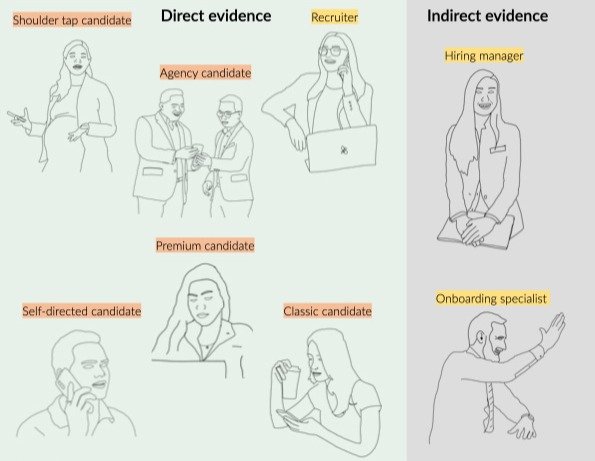
© 2021 Cognitive Ink
The experience journeys were a crucial launchpad to both understand the challenges, but also to think about opportunities for improving the experience.
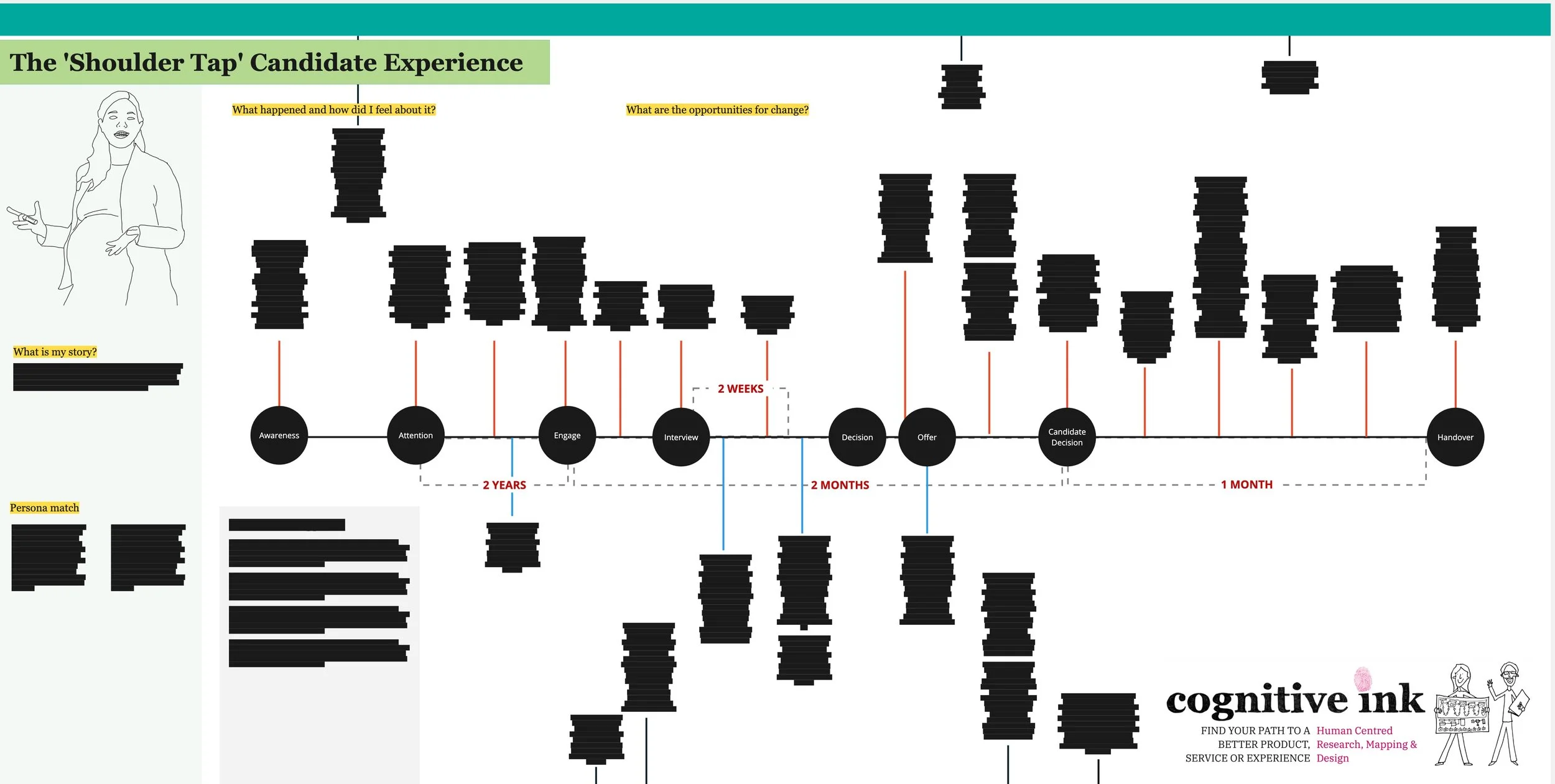
© 2021 Cognitive Ink
Insights & Outcomes
The project was a fascinating insight into an often opaque process. The hires, having recently joined the company, were still close enough to the recruitment process to speak both candidly and extensively. It helps that Cognitive Ink is always positioned as an impartial, external conversationalist and our interview results are typically anonymised.
We learned there were dozens of informational, communicational, and experiential changes that can make a world of difference to how someone perceives the hiring process. All in all, we identified 30 opportunities for further investigation.
All opportunities focused on
Providing a better overall experience for all candidates
Attracting more quality candidates
Better managing recruiter and hiring manager workloads
Supporting candidates to make better decisions
After all, issues that don’t always occur to the company running the process affect a candidate’s experience. Until the candidate is hired, the company and candidate are living in two separate worlds. For example, delays that might feel acceptable inside an organisation, can feel world-ending to someone outside, waiting for news. Communication at a few key points, may be crucial to keeping the momentum moving forward and creating a positive experience for both sides.
Auto-screening was mentioned, either via basic algorithms or more sophisticated Generative Artificial Intelligence / Large Language Models. Generally, candidates don’t like it, for it changes the power-imbalance even further.
Wherever possible, negative experiences are worth avoiding. A candidate who doesn’t join a company in the immediate term, may join in the future. Or, refer someone else. It’s a small world. Ultimately, this research focused on empowering both candidates and the client organisation.
Having successfully uncovered some crucial insights, we presented our work to leadership in both the People (Human Resources) and Recruitment sides of the organisation. Both teams gained clarity on where to focus their development efforts.